By Paper City Heating
Last updated: October 31, 2026
A single stage furnace has one heat output: full on, or off. A two stage furnace has two: a low output for mild cold and a high output for deep cold. Both heat a house, and both can serve a Wisconsin home well, but they feel different across a season that runs from November to March. The difference is not about one being simply better. It is about how often the furnace runs, how evenly rooms warm, and how the system handles the many mild days inside a long winter. See thermostat, controls, and zone heating.
Most Wisconsin winter days are not the coldest days. Even in January, with an average low near 13 degrees Fahrenheit, many days sit well above the coldest nights, and shoulder season days in November and March are milder still. A furnace that can run low on those days will cycle less, hold temperatures steadier, and move air more often, which helps rooms stay even. A single stage furnace handles the same days by firing full, warming fast, shutting off, and repeating, which works, but with wider temperature swings.
How each type runs through a winter day
Picture a November afternoon at a moderate cold. A single stage furnace fires at full output, warms the house quickly, and shuts off. The house then cools slowly until the thermostat calls again, and the cycle repeats. Rooms near the thermostat warm first, far rooms lag, and the temperature trace looks like a series of peaks and dips. That pattern is normal for single stage equipment, and many homeowners are used to it without thinking about it. See furnace installation and replacement.
A two stage furnace on the same afternoon usually fires at low output and runs longer. The house warms more slowly, but it warms more evenly, and the blower moves air through the ducts for a longer stretch, which helps far rooms catch up. When a January cold snap arrives, the furnace steps up to high output and behaves much like a single stage unit, delivering full heat when the house needs it. The staging advantage is therefore largest on mild and moderate days, which make up most of the season, and smallest on the coldest nights, when both types run hard.
Comfort and noise, room by room
Even heat is the main comfort gain from staging. Longer low runs give duct air time to reach far bedrooms, reduce the hot then cool feeling near registers, and keep floors and walls closer to the same temperature. Homeowners who notice one room always lagging, or a living room that swings warm and cool, often feel the difference most, though duct faults can still limit any furnace. Staging helps airflow reach rooms, but it cannot fix a crushed duct run or a closed damper, so duct condition still matters.
Noise follows a similar pattern. A two stage furnace at low output usually runs quieter than a single stage furnace at full output, since the burner and blower work less hard. That matters in homes where the furnace sits near a living area or a bedroom wall, and on nights when the furnace cycles often. On high output, both types sound similar, since both are working at full capacity. If quiet matters most to you, ask about blower and burner sound at both stages, not just at full output.
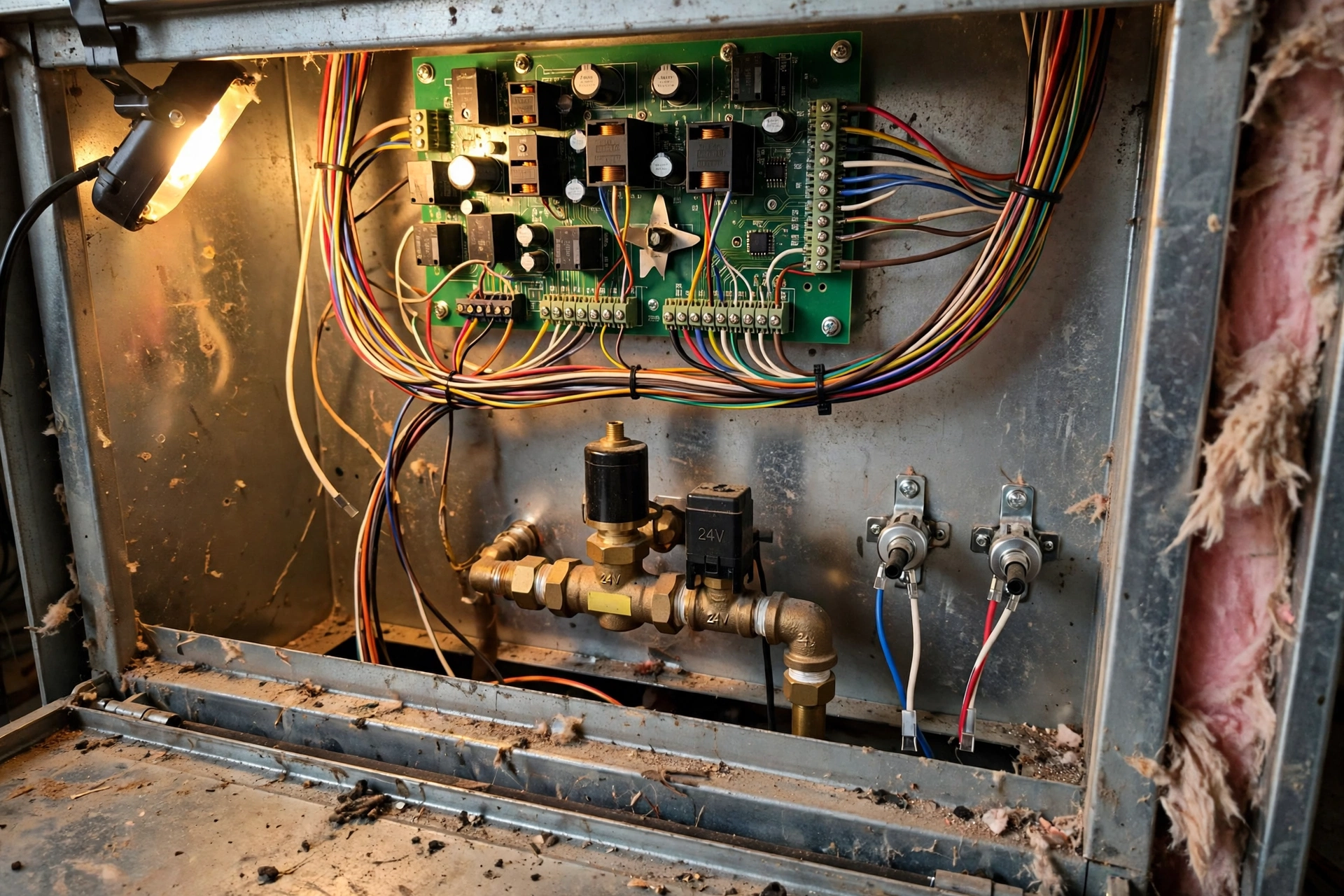
Staging lives on the control board: low-voltage wiring, relays, and a gas valve that steps between low and high fire. The board decides the stage; the thermostat only asks for heat.

Even temperatures show up in lived in rooms, not on a spec sheet. Longer low runs move air to far rooms more often, which is why staging feels different on mild winter days.
Choosing between one stage and two?
Walk us through your far rooms and temperature swings, and we will explain which pattern fits your house.
Call (920) 523-4330 Contact usEfficiency and the long season, honestly stated
Two stage furnaces often carry higher efficiency ratings than older single stage units, but staging alone does not by itself lower energy use. The real drivers are the furnace efficiency rating, correct sizing, duct condition, and house insulation. An oversized two stage furnace that short cycles on high, or a well staged furnace feeding leaky ducts, will waste heat regardless of its stage count. Sizing matters more than staging, and a furnace matched to the house, with ducts that deliver its air, will outperform a mismatched unit of either type.
The U.S. Department of Energy explains furnace efficiency and sizing in plain terms on its Energy Saver pages, and that guidance is worth reading before any replacement decision. Think of staging as a comfort and cycling feature first, and an efficiency feature second. It helps most in a house with sound ducts and a long heating season, which describes many Appleton homes, and it helps least in a house where ducts, insulation, or sizing are the real problem. Fix those first, then judge staging on its own merits.
| Feature | Single-stage furnace | Two-stage furnace |
|---|---|---|
| Heat outputs | One: full on or off | Two: low for mild cold, high for deep cold |
| Temperature pattern | Wider swings, faster warm up | Steadier, longer low runs |
| Far room comfort | More lag on mild days | Better air movement on mild days |
| Noise at low demand | Full output sound each cycle | Quieter low output most of the time |
| Cold snap behavior | Full output, as designed | High output, much like single-stage |
Which homes suit which type
A single stage furnace suits a smaller, well insulated home with short duct runs, where full output warms the house quickly and evenly enough, and where budget and simplicity matter most. It also suits a home where the furnace is a short term replacement and the duct system is sound. There is nothing outdated about a single stage furnace that is sized right and kept well. It heats, it cycles, and it serves many Wisconsin homes without fuss. See Fox Crossing furnace help.
A two stage furnace suits a larger home, a home with far rooms that lag, a home where quiet matters, or a home with a long shoulder season of mild cold days. It also suits homeowners who notice temperature swings and want steadier rooms without changing the whole duct system. The extra controls and staging parts add complexity, so the choice should weigh comfort gains against that complexity, and against the condition of the ducts and the house shell. A technician can walk the rooms, check duct capacity, and explain which pattern fits your house, rather than selling a stage count alone.
Questions to ask before you choose
Ask how the furnace will be sized for your house, not just for its square footage, but for its insulation, windows, and duct capacity. Ask whether your ducts can deliver low stage airflow evenly, and whether any duct work should come first. Ask what thermostat the system needs to use both stages properly, since staging needs the right control to work as designed. A two stage furnace paired with a control that never calls for low stage will behave like a single stage unit, and that is a waste of the feature.
Ask about maintenance too. Both types need filter care, flame sensing checks, venting checks, and safety control tests, and staging adds a second output to verify. Keep the visit record, note which stage the furnace uses most, and watch room evenness through the first winter. The right choice is the one that leaves your rooms even, your furnace cycling steadily, and your house comfortable from November to March, not the one with the most impressive label.

The payoff of staging is a room like this: steady warmth without the rush of hot air, then silence, then a rush again. Low fire runs longer and quieter, and the room notices the difference.
Staging questions from Wisconsin homeowners
Is a two-stage furnace worth it in Wisconsin?
It can be worth it for larger homes and far rooms that lag, since low output runs longer and warms more evenly on mild days. It helps less on the coldest nights, when both types run at full output, and it cannot fix leaky ducts or poor sizing. Judge it on comfort and duct condition, not on staging alone.
Does a two-stage furnace use less energy?
Staging alone does not by itself lower energy use. Efficiency rating, correct sizing, duct condition, and house insulation drive energy use more than stage count. A well sized two-stage furnace with sound ducts can use energy well across a long season, while a mismatched unit of either type wastes heat regardless of staging.
Can I use my old thermostat with a two-stage furnace?
Not always. Staging needs a control that can call for low and high output properly, and an older single-stage control may never call for low stage. Ask what thermostat the new system requires before deciding, since the wrong control turns a two-stage furnace into a single-stage unit in practice.
Staging parts: valve, board, and thermostat wire
Two-stage heat rests on three parts: a two-stage gas valve that opens partway on low fire, a control board that times the step up, and thermostat wiring with enough conductors to carry the second-stage call. The tools that judge them are a multimeter for the valve coils and a manometer for low-fire gas pressure, and the materials are copper gas line, steel heat exchanger surfaces, and low-voltage thermostat cable. Those parts are why thermostat and controls work matters as much as the furnace itself when staging is chosen.
Sizing still governs everything: a two-stage unit oversized for the house will still short-cycle, just on low fire, and the maker's sizing tables plus local code set the venting for both stages. The honest comparison is not stage against stage, but a right-sized unit against a wrong-sized one, which the sizing guide works through house by house. Comfort follows sizing; staging refines it.
| Part | Type | Job |
|---|---|---|
| Gas valve | Single or two-stage | Sets low and high fire |
| Control board | Staging timer | Times the step up |
| Thermostat wire | Multi-conductor cable | Carries the stage call |
Two-stage furnace questions
What is the difference between single-stage and two-stage furnaces?
A single-stage furnace has one heat output, full on or off. A two-stage furnace has two outputs, low for mild cold and high for deep cold. The two-stage unit runs longer at low output on mild days, which warms rooms more evenly, and steps up to high output when the house needs full heat.
Do two-stage furnaces heat better on the coldest nights?
On the coldest nights, both types run at full output, so the difference is small. The staging advantage appears on mild and moderate days, which make up most of a Wisconsin season. Cold snap performance depends more on correct sizing and duct delivery than on stage count.
Will a two-stage furnace fix my cold bedroom?
It can help if the cold room lags because of short cycles and poor air movement, since longer low runs move air to far rooms more often. It will not fix a crushed duct, a closed damper, or a badly insulated room. Trace the duct path and check insulation before expecting staging to solve a cold room.
Are two-stage furnaces noisier or quieter?
At low output, a two-stage furnace usually runs quieter than a single-stage unit at full output. At high output, both sound similar, since both work at full capacity. If quiet matters, ask about sound at both stages, and note where the furnace sits relative to living areas.
Does staging affect furnace maintenance?
Both types need filter care, flame sensing, venting, and safety checks. Staging adds a second output to verify during a visit, so the technician checks low and high operation. Keep the visit record, and note which stage the furnace uses most through the first winter.
Which type lasts longer in Wisconsin?
Lifespan depends more on sizing, installation, duct condition, and yearly care than on stage count alone. A correctly sized furnace of either type, with clean airflow and regular checks, will serve longer than a mismatched unit. Staging can reduce cycling on mild days, which helps, but it does not replace care.
Not sure which staging fits your house?
Describe your rooms, your duct layout, and your temperature swings, and we will walk through the choice with you.
Call (920) 523-4330 Contact usRelated pages
Staging is a comfort choice, and sizing is the foundation under it.
Get sizing and ducts right first, then judge one stage against two on your rooms.
Call (920) 523-4330